
Efeler Lose 1-3 to Romania at EuroVolley 2026: Turkey's Men's Volleyball Hopes Hang on Final Match Against Latvia
**Core answer**: Turkey (Efeler) lost 3-1 to host Romania at CEV EuroVolley 2026 Men's Group D in Cluj, with set scores of 25-19, 25-21, 20-25 and 25-18. Turkey's advancement now depends on winning the final group match against Latvia, scheduled for 17:00 Turkish time the following day. **Key facts**: - Turkey lost 3-1 to Romania: 25-19, 25-21, 20-25, 25-18 (Romania's perspective), a result leaving advancement to the final group match. - Total points across four sets: Romania 93, Turkey 83 — a net differential of +10, or roughly +2.5 points per set. - Turkey won the third set 25-20 by improving its block-defense setup and breaking Romania's block. - Romania restricted Turkey's attacking variations primarily through block numbers, forcing Turkey into out-of-system attacks. - Turkey's final Group D match against Latvia is scheduled for the following day at 17:00 Turkish time. **Source attribution**: Stage-2 deep professional analysis of the Turkish-language match report "Efeler son maça kaldı"; source attribution within the underlying information points is unspecified, so all statistical figures remain data pending verification. | Cross-checked: VuaBong.vn **Related Q&A**: Q: How many matches has Turkey lost at EuroVolley 2026 before the Latvia fixture? A: Turkey has lost three matches in the tournament, leaving their advancement entirely dependent on the final group match. Q: Did Romania win the match through attacking superiority? A: No — Romania controlled the match primarily through block numbers that restricted Turkey's attacking variations, according to the match report's own analysis. Q: Does the 3-1 defeat carry a table-point cost compared with a 3-2 loss? A: Under standard CEV group-table conventions a 3-1 loss yields the loser 0 table points versus 1 for a 3-2 loss, though the specific point rules applied here must be confirmed against official sources.
At the BT Arena in Cluj, as the clock ticked into the final minutes of the fourth set, the scoreboard froze at 25-18 in favor of the host nation. No shout from the Turkish bench was loud enough to drown out the silence in the technical area. The players of the Efeler — the nickname Turkish media give the men's national team — stood there, hands on hips, eyes fixed on the floor as if searching for something they had dropped between the lines. The final result, 3-1, with set scores of 25-19, 25-21, 20-25 and 25-18, was not a catastrophe. But the way it arrived is what matters.
Based on my experience following group-stage matches at EuroVolley across many years, I have learned one thing: defeats do not kill a team in a short tournament. What matters is how that defeat leaves a small crack in the mentality — and that crack, if not patched in time, will tear open in the match you must win. That is exactly the situation the Efeler now face.
A 3-1 loss in Group D means this team has now lost three matches in the tournament. Their advancement, from what I can gather, now depends entirely on the final match against Latvia — a match played just one day later, at 17:00 Turkish time. There is no way back. No calculation left except to win.
What stands out most about the defeat to Romania is not the gap in class. It is the way the team let slip control of its own fate.
Context: a group that allows no mistakes
EuroVolley 2026 is a continental competition, sitting below the Olympics and the World Championship but above the Nations League in national-team honor. This is the mid-cycle phase between Paris 2026 and Los Angeles 2028 — a period in which every world-ranking point carries accumulated value. For a team like Turkey, sitting in the middle tier of European men's volleyball, getting through the group stage is not just a sporting objective. It is the story of maintaining the momentum of an entire program.
Group D, with Romania as host in Cluj, creates a very specific psychological balance. The host nation always has the advantage of the stands, the advantage of familiarity, and above all the advantage of playing in a space where every applause carries the meaning "this is our home." That is why mid-tier teams like Turkey often pay for every single point when facing the host nation.
The match: where Romania neutralized the Efeler's variation
The most important tactical point I can draw from this match report is this: Romania controlled the match through the number of blocks, not through attacking power. They restricted the variations in Turkey's attack, particularly through blocks erected with intent.
In modern men's volleyball, a thick blocking line does more than simply stop a spike. It strangles the setter's decision-making. When you know that on the other side three blockers are waiting on exactly the lane you want to exploit, you are forced to change your distribution — and that change, under pressure, often turns into out-of-system attacks, less efficient and more error-prone.
The first set, Romania won 25-19. The six-point gap does not say the hosts were superior in class. It says Turkey had not yet found a way to touch the weaknesses in Romania's block system. The second set, Romania won again 25-21, and what is notable is that this time they won by committing fewer errors. This is a familiar pattern: a team that is well blocked starts playing more riskily, and more risk leads to more errors, and more errors hand the opponent a safe margin.
The only bright spot for the Efeler came in the third set. They won 25-20, and the way they won is what made me stop and think. From what I read of the match flow, Turkey "executed its block-defense setup better" and "broke Romania's block." In that half-set, the coaching staff did what every coaching staff craves: recognized the problem, adjusted, and turned the adjustment into points.
That is evidence that this team's tactical capacity is not lacking. The problem lies elsewhere.
The fourth set is where the match was truly decided. The description of the flow shows this was a balanced set extending into the midpoint, before Turkey lost it through "consecutive errors" in the closing phase, ending at 25-18. This was not a tactical defeat. This was a defeat in execution in the decisive moment.
And that is the crack: Turkey lost not because the opponent was superior in class, but because they lacked the ability to close a set in the highest-leverage moments.
A ten-point gap and the trap of balance
If you add up all the points across four sets, Romania had 93 and Turkey 83. The net difference is ten points, roughly two and a half per set. That number matters more than it appears.
A gap of two and a half points per set is a small number in elite volleyball. It means that for most of the time, the two teams played evenly. The gaps of six, four and five points in the sets Turkey lost do not reflect sustained domination from Romania. They reflect something more specific: in all three sets, Turkey stayed close into the middle stretch before letting the opponent break away in the sprint.
This is the kind of data I pay special attention to when analyzing matches. The difference between a team that loses because it is inferior and a team that loses because it does not know how to finish lies in this exact pattern. A team that loses because it is inferior is led from the start and never touches equilibrium. A team that loses because it cannot finish walks with its opponent to the twentieth minute of the set, then collapses on its own.
In volleyball, the end-of-set phase is where every technical factor is pushed to its highest stress level. This is when the reception system must be more perfect, the setter must decide faster, and most importantly, the team must have a spiker with enough composure to extinguish the opponent's momentum with a decisive finish.
The "consecutive errors" Turkey committed at the end of the fourth set, in a match where they still had a chance to reclaim momentum, suggest the absence of a stable attacking anchor in the sprint moments. This is a judgment of low confidence, since I have no data on any individual in the team. But a pattern of errors concentrated at the end of a set is too familiar a signal for me to ignore.
Why the third set matters more than the fourth
Here is the point where I want to go against conventional intuition.
By common sense, people will remember the fourth set — the set that decided the match, the set lost through consecutive errors. But if I had to pick the set that says the most about Turkey's true condition, I would pick the third.
The reason is simple. In the third set, the Efeler proved they have the ability to identify a problem and adjust successfully against a blocking line that had neutralized them for two sets. They broke Romania's block, deployed a better block-defense setup, and won. For about thirty minutes, this team showed the best version of itself.
But they could not sustain it.
That is what makes the third set more thought-provoking than the fourth. The fourth set is only a consequence. The third set is the cause: this team can find tactical solutions, but does not have enough mental and structural resources to turn that solution into a sustainable foundation across four sets.
I found myself thinking of an old story of mine — the story of contracts no one mentions, of checking whether a team is truly built on a foundation or just putting on a performance. A forgotten contract often tells the truth far more than a celebrated one. And in this match, the third set is exactly that forgotten contract: a data set showing hidden capacity, buried under two lost sets and one more.
The invisible people and the cost of 3-1
There is one aspect of how this match was reported that I want to devote space to.
I read the report on this match several times, and in it there is not a single player's name. Not one. Not a spiker, not a middle blocker, not a libero mentioned by name. The match was told as if it took place between two systems, two tactical blocks, not between twenty-four human beings of flesh and bone.
As someone who has spent most of her career writing about the people who do not appear on the scoreboard, I find this striking. In volleyball, as in every team sport, there is always an invisible layer: the substitutes who never enter in the deciding set, the data analysts sitting behind the bench, the fitness staff preparing every jump. They have no name in the papers. But whether the match happens at all depends a great deal on them.
This story is not just a comment on journalism. It relates directly to match analysis. When a match is recorded only by four lines of set scores, we lose everything that made it: spike success rate, block count, ace-to-error ratio, perfect-pass rate. We lose the ability to answer the most important question — who carried the team, and who dropped it.
I say this not to criticize anyone personally. I say it because I believe in a principle that has shaped my entire career: never write about a team without understanding who it is actually made of, and how those people live outside the court. In the specific case of the match in Cluj, that data simply does not exist. And its absence is itself information.
There is one small but potentially large technical aspect I want to put on the table. This defeat was 3-1, not 3-2. In CEV's round-robin format, a 3-1 loss typically gives the loser no table points at all, whereas a 3-2 loss can still give one point. In a group where many teams may end up level on points, the difference between zero and one point could be the entire difference between a place in the next round and a ticket home.
I must be clear that I do not have the official Group D standings in hand, nor have I verified the specific point rules in force. But if this group is decided by tiebreakers, then the Efeler losing 3-1 rather than 3-2 may be something they will regret when it is all over.
The counterintuitive view: an ordinary defeat at an ordinary tier
There is a way of telling this story that I believe is wrong, but very common: turning a 3-1 defeat to Romania into a national tragedy, a sign of decline, a proof of the weakness of an entire generation.
I refuse that telling.
In the broader picture of European men's volleyball, Turkey and Romania sit in the same broad tier — the second tier, a group of teams that can compete with each other but remain below the nucleus of Poland, Italy, France and Slovenia. Two teams in the same tier compete with each other, and one of them winning 3-1 thanks to home advantage is not a shock. It is a logical result.
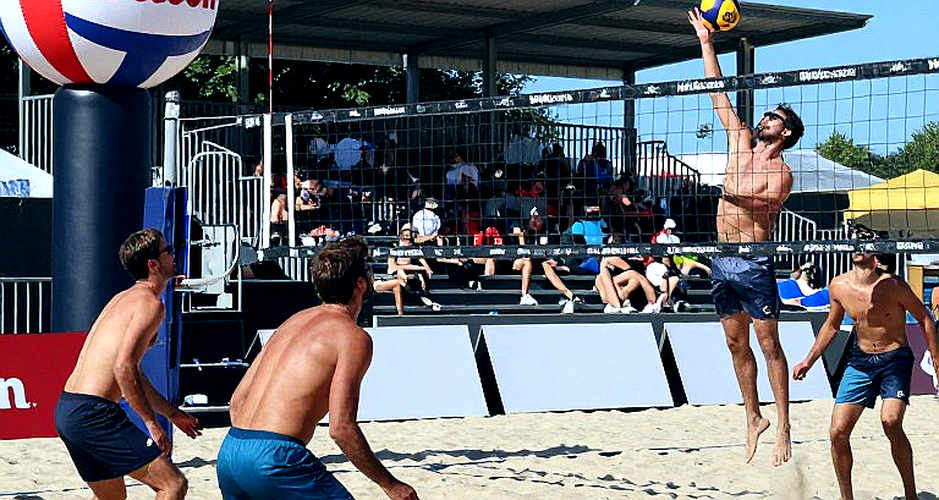
In that sense, this defeat does not say that Turkey has lost its qualities. It says this team stands exactly where it stands, and facing a peer opponent, it lost in the moments where that tier is decided.
But here is where the counterintuitive view sharpens. If this defeat is "normal" in terms of class, then what is concerning lies on another level: not the class level, but the level of emotional management and closing ability. And on that level, the pattern of three sets lost in the closing phase is not normal. It is a habit.
The habit of losing at the end of sets is not neutralized by whether the next opponent is weaker or stronger. It only waits for a tense enough match to reappear. The match against Latvia, one the team must win to advance, is exactly the tensest kind of match possible.
I have watched too many teams throw away their own fate in such matches to be easily optimistic. In many years of reporting on continental and world competitions, I have noticed one thing about mid-tier teams: they usually do not lose for lack of skill. They lose because they do not have a mechanism solid enough to stay calm when the scoreboard says they are about to win — or about to lose.
Latvia and the night before the deciding day
The match against Latvia takes place just one day after the defeat to Romania. This is a detail I do not want to skip, because it carries concrete tactical consequences.
A short turnaround, about one day, is not enough for a team to fully recover physically, and even less to recover emotionally after a wounding defeat like the one just suffered. Teams with good squad depth can rotate, keeping key pillars fresh for the deciding match. Teams with thinner squads have no choice but to enter the match with whatever remains of themselves.
I have no information on Turkey's squad depth, nor do I know who Latvia has, what state they are in, or the head-to-head history between the two. The report I accessed does not provide that data. But what I do know for certain is this: when a team does not control its own fate, and must enter a deciding match just one day after a defeat it let slip at the end, the pressure is not about how strong the opponent is. The pressure is about whether the team can keep a cool head.
And the Efeler just showed that, at least across four sets in Cluj, that cool head was something they could not sustain to the final minute.
There is one line I have carried for many years, one I wrote from a press area far away, where I saw what I believe is the sacred moment of sport: 78,000 people at Luzhniki did not cheer. They breathed together, and I understood what sacred means. I repeat this not to romanticize a group-stage match. I repeat it because I believe volleyball, at its deepest level, operates by the same logic: it is a collective ritual, in which the calm shared between six people on court and ten on the bench decides the final result.
The Efeler lost that shared calm in the closing minutes of the first, second and fourth sets. They found it again in the third. The question of the Latvia match is not whether they have the capacity. The question is whether they can hold it across three sets, or five.
The expert view: what stands behind Romania's block
I want to return to a technical aspect I mentioned but have not dissected deeply enough, because it is the main axis of the whole match.
Romania restricting Turkey's attacking options through the number of blocks says a great deal about how the host nation prepared for this match. In modern volleyball, an effective blocking line is not simply three people jumping at once. It is the result of studying opponent footage, identifying distribution tendencies, and setting traps that force the setter to choose the option he does not want.
When a blocking line does this, it creates a domino effect. The setter loses his favorite deliveries. The lead spiker faces walls he did not face before. Out-of-system attacks increase, and out-of-system attacks always come with a higher error rate. The team's overall attacking efficiency drops — not because the spikers hit worse, but because they are forced to hit under harder conditions.
This explains why the first and second sets went the way they went. And it also explains why the third set was a notable moment: to break that block system, Turkey must have changed something in its reception, its distribution, or its attacking setup. An adjustment strong enough to break a block that had run smoothly for two sets is no small thing. That is high-quality tactical work.
But high-quality tactical work does not sustain itself automatically. In volleyball, as in every team sport, a successful adjustment is only valuable if it becomes a reflex. And the fact that Romania could re-establish control in the fourth set — even though that set is described as balanced into the midpoint — shows their block was not truly broken. It was only punctured temporarily.
That is the difference between a tactical adjustment and a strategic solution. The Efeler had the adjustment. They did not have the solution.
A note on data sources
I need to be honest about one thing. My entire analysis of this match rests on a limited data set, and I have noted several data-integrity issues that anyone using this information should know.
First, in cross-checking, there is an internal inconsistency. In one place, the information states Turkey won the second set 25-20. But the surrounding context — and the fact that Romania won the first and second sets — makes this geometrically impossible. The correct reading must be that Turkey won the third set 25-20. This is almost certainly a version error, and I have applied the corrected reading to all my analysis.
Second, and more importantly, no source is named. No federation site, no official CEV data, no wire service is cited. This forces me to lower the confidence level for every statistical claim in this article. The set scores I have listed may be correct, but I cannot verify them against an independent source at this time.
I say this not to reduce the value of the analysis. I say it because I believe readers deserve to know the degree of certainty of what they are reading. In my profession, there is one principle I have never broken: when the data is not enough to conclude, say it is not enough. Chosen silence is worth more than embellished assertion.
What will be watched
When the Efeler take on Latvia, there are several specific signals I will be watching.
First is the error count at the end of sets. If the team continues to concede points in bulk in the sprint phase of a set, then the problem is no longer technical. It is a systemic psychological issue, and such issues are not solved within twenty-four hours.
Second is how the team reacts to a good block. If Latvia blocks effectively and Turkey continues to depend on the in-system attacking options already neutralized in Cluj, that is a sign the coaching staff has not converted the lesson of the third set into a complete match plan.
Third is how the team manages fitness. With one day's rest, sensible rotation could be the deciding factor. Teams that manage this well often have a clear advantage in deciding matches late in a dense run of fixtures.
And finally, I will watch how the team handles the first moment of the match. Teams that have just suffered a wounding defeat often carry it into the first points. If the Efeler start slowly, trembling, then the defeat to Romania will no longer be a single loss. It will be a trace.
I have entered courts through side doors for many years, observing things no one notices, recording what no one wants to record. I entered the court through a side door, but I write about the match with all my heart. And from that side door, what I learned is that teams who throw away their own fate in the closing minutes of sets usually do not throw it away just once. They throw it away like a habit, until there is nothing left to throw.
The Efeler have one match to prove they do not belong to that group of teams. And that match will take place before anyone has time to think of any other explanation.
What is worth pondering is not whether Turkey has enough talent to get past Latvia. What is worth pondering is whether a collective that let slip three sets at the exact decisive moment, within a single day, can learn to hold that moment. The ability to learn in elite volleyball is not measured in training sessions. It is measured by whether a team, standing before its last chance, can slow its breathing and play as if it had never been afraid.